Saturday, 7 December 2013

Saqlain Mushtaq

Saqlain Mushtaq 


Source (google.com.pk)

Biography

Saqlain Mushtaq was born in Lahore on December 29, 1976, the son of a government clerk. His father never played cricket but his two elder brothers did. The nine-year-old Saqlain was sometimes allowed to bowl in the nets at his brothers’ club. He never got a chance to play at school, but by 13 was an all-rounder in the Zariff Memorial Club Second XI. It was always off spin for Saqlain. “I never wanted to be a quick bowler. I was very skinny and never had too much strength in the body. I just played for enjoyment, never thinking I would be a pro. But my brothers and the club coach Ahmed Hassan thought I had a future. No one ever told me, though. It was only discussed with my brothers. The big step which turned my life was when

I was 14 and went to the MAO (Mohammedan Anglo-Oriental) College. I got a new coach there, Mumtaz Akhtar Butt. I played for college for three years and we won the championship three years.”

However, he ascribes the secret of his wrong’un, better known as the ‘Doosra’, to the yard and street cricket he played as a teenager, at his home in Lahore, with relatives and neighbourhood boys. “We would get up at 4.30am, go to the mosque and then play a Test match. We drew lines in chalk on the walls for wickets. We would bet soft drinks or a dinner on the result. I used a tennis ball bound with electric tape. Then it goes a bit quicker, swings and dips. You can make it go both ways.”

Saqlain made his first-class debut in 1994/95, aged 17. He took 52 wickets in his first season and was picked to represent Pakistan A in a one-day tournament in Dhaka. Full international recognition came quickly in September 1995, after Saqlain got seven wickets for the PCB Patron’s XI against the touring Sri Lankans. His Test debut came three days later, at Peshawar: he took four wickets in that game and five in the next. By the end of 1999, his total had reached 107 in 24 Tests and 210 in 111 one-day internationals; he was the quickest bowler in history to reach 100, 150, 200 and 250 one-day international wickets.

Wasim Akram believes he is one of the greatest off spinner he has seen. “He is as aggressive as a fast bowler, not afraid of getting hit, and has this total belief in himself.”

Saqlain joined Surrey in 1997, a step which he considers to have been wholly beneficial. “Before that I had never really bowled much. In England, you play every day, sometimes 10 days continuous. I’ve learned so much from different weather, pitches, conditions, different players, stances, techniques.” Last summer he played seven games after the World Cup, taking 58 wickets at an extraordinary 11.37. A knee injury in that August prevented him playing the final games, but Surrey were already assured of the title by then.

During the World Cup of 1999, Saqlain claimed 17 wickets, including a hat-trick against Zimbabwe, but time has not lessened the pain he felt when Pakistan lost the final to Australia. “I left the team hotel and went back to my London flat and cried. For two days I didn’t speak to anyone apart from my wife. She helped me pull through.” Helping Surrey to the County Championship helped the healing process.

The injuries only worsened and by 2002 he was regularly taking painkillers by the bucket load before stepping out onto the field. The ligament at the back of his left knee had ripped so he began putting the load onto his right leg, until the same occurred on his right knee.

Many operations later he was given a chance to prove himself in 2005 by PCB, but unfortunately Sehwag was in full form and he was in excruciating pain. He bowled with all his heart but the injuries proved to be too much. He is now retired from international cricket, with his achievements in abundance and his records still intact.

Saqlain Mushtaq


Saqlain Mushtaq


Saqlain Mushtaq


Saqlain Mushtaq


Saqlain Mushtaq


Saqlain Mushtaq


Saqlain Mushtaq


Saqlain Mushtaq


Saqlain Mushtaq


Saqlain Mushtaq

Saqlain Mushtaq


Saqlain Mushtaq


Saqlain Mushtaq


Inzamam-ul-Haq

Inzamam-ul-Haq 


Source (google.com.pk)

Biography

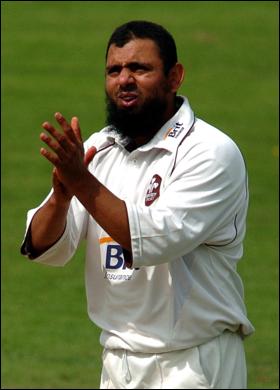
Inzamam-ul-Haq (born 3 March 1970) is a Pakistani cricketer. He is considered to be one of Pakistan’s best batsmen.He is currently the captain of the Pakistani team.Test Debut: Pakistan v England at Birmingham, 1st Test, 1992. His career highlights are:

Scoring 60 in 37 balls against New Zealand in the semifinal of the 1992 World Cup to win the match that was nearly lost.
Scoring 329 against New Zealand in Lahore during a Test in the 2001-02 season (the twelfth highest score by a batsman)
Scoring 138* to deny Bangladesh victory at Multan.
Becoming the second batsman to score 10,000 runs in one-day inernationals (behind Sachin Tendulkar)
Scoring 184 in his 100th Test, against India at Bangalore in 2005.

Inzamam ul-Haq is well-known for his poor running between the wickets (as of May 2005, he has been run out a record 38 times in one-day internationals) and his ability to play shots around the ground. He has been described as looking “like a passenger in the field”.

He averages just over 50 runs per innings in tests and nearly 40 runs in one-day internationals with a strike rate of 53.65 and 74.20 respectively (figures current as of May 2004). He is called the best batsmen in the world against pace by Imran Khan. Inzamam is a giant that has a very soft touch for a man of his bulk. He usually bats at number three with his sidekick Yousuf Youhana.

He plays shots all round the wicket, is especially strong off his legs, and unleashes ferocious pulls and lofted drives.
Inzamam-ul-Haq is a symbiosis of strength and subtlety. Power is no surprise, but sublime touch is remarkable for a man of his bulk. He loathes exercise and often looks a passenger in the field, but with a willow between his palms he is suddenly galvanised. He plays shots all round the wicket, is especially strong off his legs, and unleashes ferocious pulls and lofted drives. Imran Khan rates him the best batsman in the world against pace. Early on he is vulnerable playing across his front pad or groping outside off stump. He uses his feet well to the spinners, although this aggression can be his undoing. Inzi keeps a cool head in a crisis and has succeeded Javed Miandad as Pakistan's premier batsman, but his hapless running between wickets is legendary and most dangerous for his partners. There were no such problems against New Zealand at a boiling Lahore in 2001-02, when Inzamam belted 329, the second-highest Test score by a Pakistani and the tenth-highest by anyone. However, he was then dogged by poor form, scoring just 16 runs in Pakistan's ill-fated World Cup campaign in 2003. He was dropped from the team briefly, but then roared back to form, scoring a magnificent unbeaten 138 and guiding Pakistan to a thrilling one-wicket win against Bangladesh at Multan. He was rewarded with the captaincy of the team, and despite leading them to victory in the Test series in New Zealand, question-marks about his leadership qualities surfaced when Pakistan were beaten in both the Test series and the one-dayers against India. But the selectors persevered with him and this bore results when he took a team thin on bowling resources to India and drew the Test series with a rousing performance in the final Test, Inzamam's 100th. After scoring a magnificent 184, Inzamam led the team astutely on a tense final day and took Pakistan to victory. Since that day, Inzamam has gone from strength to strength as captain and premier batsman. By scoring a hundred against West Indies in June 2005, he kept up a remarkable record of matchwinning centuries, amongt the best of modern-day batsmen. A magnificent year ended with Inzamam leading his team to triumph over Ashes-winning England; personally the series was arguably his best ever. He never failed to make a fifty, scored twin centuries at Faisalabad for the first time, going past Miandad as Pakistan's leading century-maker and joining him as only the second Pakistani with 8000 Test runs. As captain, he never looked more a leader, uniting a young, inexperienced team and turning them, once again, into a force to matter globally. The turn of the year brought contemplation; he missed the Test victory over India at Karachi with a persistent back injury. The subsequent ODI thrashing also raised concerns about Inzamam as ODI captain, none of which were entirely wiped away during ODI and Test wins in Sri Lanka. Pakistan were then beaten comprehensively in the Test series in England though all was forgotten - including Inzamam's own poor form - by events at The Oval. There, Inzamam, astonishingly for a man perceived as so insouciant, became the most controversial figure in cricket for a week, leading his side off the field in protest at charges of ball tampering made by umpires Billy Doctrove and Darrell Hair. They refused to come out at first, then delayed the start before eventually forfeiting the Test, the first time in the history of the game. In Pakistan, he became a national hero, saviour of a country's pride and honour. Though nobody is saying it just yet, the World Cup 2007 is likely to be his last act.
In the old city of Multan, near the Ghanta Ghar, a winding lane leads to Mohalla Toia Alam Shah. It was in the courtyard of a house in this Mohalla, that young Inzamam-ul-Haq learnt to hold a bat. A door at the back of the courtyard leads to a place where Inzamam played cricket with his neighbors. Inzamam had a nice childhood. He was youngest of the 5 brothers and one sister. His elder brothers took care of all his needs. Inzamam did his schoolings in the Muslim School in Multan. Across that school was a small ground where Inzamam joined a cricket coaching camp and started an interest in cricket. The same cricket ground is now a Pakistan Cricket Board Coaching centre.

And about Inzamam, "He has always been a calm and reserved person. He was different from the others. He belonged to a religious family; he never watched movies or listened into music. He eats and sleeps a lot though," says Hussain, who first captained Inzamam in the under-19s and then later for Multan

Inzi, as he is mostly known in his team and by his supporters, is Pakistan's main middle order batsmen, if he clicks then on most occasions Pakistan either wins or leads the charge, like most leading batsmen in the world, the team tries to bat around him. His appearances may be deceiving. With his slow walk and bulky appearance he may be considered as a dormant player. But Inzamam has the ability to launch brutal attacks at times. He displays a perfect blend of power and timing. Power is no amazing thing for a man of his size, but his timing of the ball is fascinating. He can play shots all around the wicket and is very strong especially on his leg side. Inzamam is the captain and a key player of the Pakistan team. Imran Khan was the one who identified the potential of this man. Once he saw Inzamam play fluently against the pace attack of Wasim and Waqar in the nets. Imran was so impressed by his batting that, he decided to make Inzamam play in all the matches of the 1992 World Cup, no matter how he performs.

Inzamam plays fast bowling extremely well. Though there is no much flaw in his techniques, he has a tendency to throw away his wicket by the silliest mistakes. A very poor runner between the wickets, he makes himself and his partner uncomfortable with his running. Inzamam also has the tendency to move his foot across when playing fast bowlers, which at times makes him judged out for leg before wicket. But against the spinners he uses his feet well.

Inzamam is very cool and composed and has succeeded Javed Miandad as a premier batsman for Pakistan. With a huge responsibility of building a strong team, he seems to perform well as a captain.

Inzamam-ul-Haq is a symbiosis of strength and subtlety. Power is no surprise, but sublime touch is remarkable for a man of his bulk. He loathes exercise and often looks a passenger in the field, but with a willow between his palms he is suddenly galvanized. He plays shots all round the wicket, is especially strong off his legs, and unleashes ferocious pulls and lofted drives. Imran Khan rates him the best batsman in the world against pace. Early on he is vulnerable playing across his front pad or groping outside off stump. He uses his feet well to the spinners, although this aggression can be his undoing. Inzi keeps a cool head in a crisis and has succeeded Javed Miandad as Pakistan's premier batsman, but his hapless running between wickets is legendary and most dangerous for his partners. There were no such problems against New Zealand at a boiling Lahore in 2001-02, when Inzamam belted 329, the second-highest Test score by a Pakistani and the tenth-highest by anyone. However, he was then dogged by poor form, scoring just 16 runs in Pakistan's ill-fated World Cup campaign in 2003. He was dropped from the team briefly, but then roared back to form, scoring a magnificent unbeaten 138 and guiding Pakistan to a thrilling one-wicket win against Bangladesh at Multan. He was rewarded with the captaincy of the team, and despite leading them to victory in the Test series in New Zealand, question-marks about his leadership qualities surfaced when Pakistan were beaten in both the Test series and the one-dayers against India. But the selectors persevered with him and this bore results when he took a team thin on bowling resources to India and drew the Test series with a rousing performance in the final Test, Inzamam's 100th. After scoring a magnificent 184, Inzamam lead the team astutely on a tense final day and took Pakistan to victory.
A well experienced and an explosive batsman, capable of fast scoring or keeping his wicket when his team needs him the most. One of his great achievements includes, his highest score of 329, the second-highest Test score by a Pakistani and the tenth-highest by anyone. One of Pakistan's leading match winners in difficult circumstances. Inzamam has led his team out of difficult situations numerous times. Once he is set, becomes very hard to dismiss.


Inzamam-ul-Haq


Inzamam-ul-Haq


Inzamam-ul-Haq


Inzamam-ul-Haq


Inzamam-ul-Haq


Inzamam-ul-Haq


Inzamam-ul-Haq


Inzamam-ul-Haq


Inzamam-ul-Haq


Inzamam-ul-Haq


Inzamam-ul-Haq
 

Inzamam-ul-Haq


Inzamam-ul-Haq

 Inzamam-ul-Haq

WAQAR YOUNIS

WAQAR YOUNIS 


Source (google.com.pk)

BIOGRAPHY

Waqar Younis Maitla (Punjabi: وقار یونس, born 16 November 1971) is a former Pakistani right arm fast bowler in cricket and widely regarded as one of the greatest fast bowlers of all time. To date (2011), he holds the record for the youngest Pakistani Test captain and the third youngest Test captain in history (22 years 15 days).[1]
He was best known in cricket for his ability to reverse swing a cricket ball at high speed . He took 373 Test wickets and 416 One Day International wickets during his career. He is considered to be the best exponent of the swing bowling delivery. Younis has the 2nd best strike rate for any bowler with over 200 Test wickets. He worked as a bowling coach with the national side from 2006 to 2007.
Younis was appointed as the coach of the Pakistan cricket team on 3 March 2010.[2] He resigned as Pakistan’s Cricket Coach on 19 August 2011.[3]
Younis was born in Vehari, Punjab in Pakistan. He was educated in Sadiq Public School in Bahawalpur in Pakistan, the Pakistani College (Pakistan Islamia Higher Secondary School) in Sharjah and the Government College in Vehari. He was raised in Sharjah in the United Arab Emirates, where his father was a contract worker. He returned to Pakistan during his adolescent years and there, he started playing cricket.
He is married to Dr. Faryal Waqar Younis, a Pakistani Australian[4] with a son Azaan Waqar and a daughter Maira Waqar and now lives in Castle Hill in Australia.[5] Younis has also worked as a television sports commentator for the Nine Network in Australia and for Ten Sports in the United Arab Emirates.
Younis is one of several Pakistani fast bowlers, beginning with Sarfraz Nawaz, who have been successful at bowling reverse swing. In partnership with Akram, Younis opened the Pakistan bowling attack in the 1990s. Cricket critics and scholars attribute Younis and Akram to be one of the most effective fast bowling partnerships in cricket, due to their ability to swing the ball at high speed. The ability to reverse swing and his speed led to him becoming one of the most talented bowlers in modern cricket.
Younis explained his ability to reverse swing by the manipulation of an old ball; with one side shiny, one side rough, the ball would move in the opposite direction to conventional swing. This led to Younis having the ability to bowl inswingers and outswingers in the cricket pitch and in effect both Younis and Akram became successful in taking wickets by this variation of swing bowling. His fastest delivery in cricket was 153 km/h or 95.1 mph, a delivery he bowled against South Africa in 1993. He was also effective in the use of bouncers or short pitch deliveries; Younis’ bowling against South Africa in Sheikhupura in Pakistan, is remembered for his effective use of the short pitched delivery.
Following Pakistan’s victory during the Test match series versus England in 1992, the English media were suspicious of the reverse swing delivery. It was relatively unknown to the cricketing world during that period and this led to accusations of foul play by critics, however cricket officials found no evidence of foul play and the skill of the reverse swing delivery has been accepted in cricket.
Sri Lanka fast bowler, Lasith Malinga, who became the first bowler in World Cup history to take two hat-tricks, has said that he learnt to bowl his deadly yorkers by watching Pakistan’s legendary pair of Wasim Akram and Waqar Younis.[17] No doubt over the years several bowlers have learned and mastered the skill of reverse swing but there are still some techniques which haven’t have been explored e.g. banana swing. Title of Banana swing bowler was given to Waqar Younis because of his unique technique of swinging the ball in the air at very high speed before hitting the ground. In most of his hat tricks he has delivered banana swing balls which were unplayable.
Despite his qualities as a fast bowler, he was expensive at times and sometimes lacked the consistency of bowlers such as West Indian fast bowler Curtly Ambrose and Australian fast bowler Glenn McGrath. This may be partly due to the mentality of his former captain, Imran Khan, who prioritised aggression and speed.


WAQAR YOUNIS
WAQAR YOUNIS

WAQAR YOUNIS

WAQAR YOUNIS

WAQAR YOUNIS

WAQAR YOUNIS

WAQAR YOUNIS

WAQAR YOUNIS

WAQAR YOUNIS

WAQAR YOUNIS

WAQAR YOUNIS

WAQAR YOUNIS

WAQAR YOUNIS

WAQAR YOUNIS

WASIM AKRAM

WASIM AKRAM 


Source (google.com.pk)

BIOGRAPHY

Full name : Wasim Akram
Nickname : WAZ,Sultan of Swing
Born : 3 June 1966
Birth Place : Lahore,Pakistan
Wife : Huma Mufti
Child : 2 Sons (Taimur and Akbar)
Diabetes Type: 1
Nationality : Pakistani
Batting Style: Left-Hand Bat
Bowling Style: Left-Arm Fast
Major Teams: Pakistan, Hampshire, Lahore, Lancashire, Pakistan Automobiles Corporation, Pakistan International Airlines.
Role : (All-rounder) bowler and batsman.
Test debut : 25 January 1984 v New Zealand
Last Test : 9 January 2002 v Bangladesh
ODI debut : 23 November 1984 v New Zealand
Last ODI : 1 March 2003 v India

Early and Personal Life :
Wasim Akram is a famous cricketer of the world.He was born in 3 June 1966 at Lahore,Pakistan . He was educated at Islamia College in Lahore, Pakistan. He played as an opening bowler and batsman at Islamia College. His family was middle-class.In 1988 he signed for Lancashire County Cricket Club in England and went on to become their most successful overseas players.Displaying tremendous talent and flair in Test cricket, Akram attracted the attention of Pakistani All-rounder, Imran Kahn.Akram made his Test cricket debut for Pakistan against New Zealand in 1985.His ODI debut was 23 November 1984 v New Zealand.Wasim Akram was a significant figure in the 1992 Cricket World Cup held in Australia, when Pakistan won the tournament. In the final against England, his batting performance during his innings of 33 runs off 19 balls, pushed Pakistan to a respectable score of 249 runs for 6 wickets. At the 1992 Cricket World Cup, Akram’s new style of swing proved deadly and the Pakistan National Team won the tournament.Wasim retired in 2003, after a brief spell with Hampshire in England. Since then, Wasim has taken up commentary and can currently be seen as a sportscaster for the ESPN Star network, and is also running shows on ARY Digital.

    In his Test career, Wasim took 414 wickets in 104 matches, a Pakistani record, at an average of 23.62, and scored 2,898 runs, at an average of 22.64.

    In One-Day Internationals, Wasim took a world record 502 wickets in 356 appearances, at an average of 23.52, and scored 3,717 runs, at an average of 16.52.

    Wasim was the first bowler in international cricket to take more than 400 wickets in both forms of the game, and only Muttiah Muralitharan has since achieved this.

    Wasim Akram also held the record for the most wickets in Cricket World Cups — a total of 55 in 38 matches. Australia’s Glenn McGrath broke the record during the 2007 World Cup, ending with a final tally of 77 from 39 matches.On passing Wasim’s record, McGrath said, “Wasim Akram, to me, is one of the greatest bowlers of all time. Left-armer, swung it both ways with the new ball and he was so dangerous with the old ball. To go past him is something I will always remember. Probably the other side of the coin is that if you play long enough, you’re going to break records here and there.”

    Uniquely, Wasim took four hat-tricks in international cricket, two each in Tests and ODIs. He is one of only three bowlers to have taken two Test hat-tricks (the others being Hugh Trumble and Jimmy Matthews), and also one of only three bowlers to have taken two ODI hat-tricks (the others being fellow Pakistani Saqlain Mushtaq and Chaminda Vaas of Sri Lanka). Wasim’s Test hat-tricks are unique, since they were taken in consecutive Test matches in the same series, against Sri Lanka in 1999. Wasim is also one of only two bowlers to have taken both a Test and ODI hat-trick (the other being fellow Pakistani Mohammad Sami).

    Playing in a Test against the West Indies at Lahore in 1990-91, he became one of only six players to have taken four wickets in an over during a Test match. In Wasim’s case, the feat was not part of a hat-trick, the third ball of the series being a dropped catch, which allowed a single.

    Wasim has also achieved the highest score by a number eight batsman in Test cricket — 257 not out from 363 balls against Zimbabwe at Sheikhupura. The innings contained 12 sixes which is also a world record for Test crick

    He also has the joint-highest number of Man of the Match awards in Test cricket, along with South African Jacques Kallis, with 17


WASIM AKRAM

WASIM AKRAM


WASIM AKRAM


WASIM AKRAM


WASIM AKRAM


WASIM AKRAM


WASIM AKRAM


WASIM AKRAM


WASIM AKRAM


WASIM AKRAM


WASIM AKRAM


WASIM AKRAM


WASIM AKRAM


WASIM AKRAM